On this page 10 sections
- How much niacin is in one JellyGlow Gummies serving?
- Which form of niacin do JellyGlow Gummies use?
- Do JellyGlow Gummies cause niacin flush?
- What does the niacin skin claim on the label mean?
- Is 25 mg of nicotinamide under the upper limits?
- Should you add up niacin from other supplements?
- Does a niacin rash mean you need JellyGlow Gummies?
- Who should ask a doctor before taking the niacin in JellyGlow Gummies?
- What does niacin research tell us about JellyGlow Gummies?
- FAQ
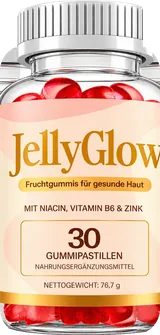
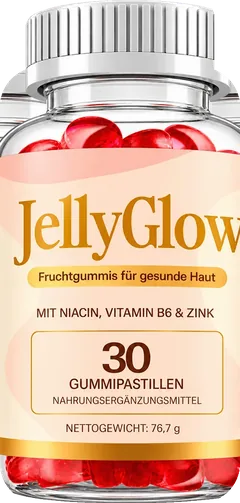
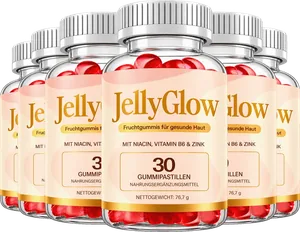
JellyGlow Gummies niacin comes as 25 mg NE of nicotinamide in each gummy, which the label prints as 156% of the EU Nutrient Reference Value. Niacin is the nutrient behind the one health statement on the jar, "Niacin contributes to the maintenance of normal skin," and this page explains what that sentence means, which form of niacin is used and how 25 mg sits against the EU and U.S. upper limits.
How much niacin is in one JellyGlow Gummies serving?
One gummy contains 25 mg NE of niacin, and the suggested serving is one gummy a day. The label prints the amount in its Nutritional Information table, and the official JellyGlow sales page lists the same figure1.
"NE" stands for niacin equivalents, the unit used for niacin on nutrition tables. The percentage on the label compares 25 mg with the EU adult Nutrient Reference Value (NRV) for niacin, which is 16 mg2. Our math: 25 ÷ 16 = 1.56, so the label's 156% checks out.
Here is how niacin sits next to the other two vitamins and minerals on the label:
| Nutrient (per gummy) | Amount | EU NRV | % NRV on the label |
|---|---|---|---|
| Niacin (as nicotinamide) | 25 mg NE | 16 mg | 156% |
| Vitamin B6 | 2 mg | 1.4 mg | 143% |
| Zinc | 1.5 mg | 10 mg | 15% |
The NRVs come from the EU food information rules2; the amounts and percentages come from the label. You can read more about the other two nutrients on our vitamin B6 page and zinc page, and see every line of the recipe in the ingredients guide.
Which form of niacin do JellyGlow Gummies use?
JellyGlow Gummies use nicotinamide, which appears by name in the label's ingredient list. The label does not list nicotinic acid, the other common supplement form.
That detail matters because the two forms behave differently. The U.S. National Institutes of Health Office of Dietary Supplements (NIH ODS) says the main supplement forms of niacin are nicotinic acid and nicotinamide, and that nicotinamide does not cause skin flushing and has fewer side effects than nicotinic acid3. Germany's Federal Institute for Risk Assessment (BfR) also notes that the two forms have different safety profiles, which is why it suggests separate maximum amounts for each in food supplements4.
Nicotinamide sits about ninth in the ingredient list, after the sugars, water, maca extract, pectin, citric acid, L-citrulline and L-carnitine. EU labels list ingredients in descending order of weight2, so niacin is a small part of each roughly 2.56 g gummy (76.7 g ÷ 30, our math).
| Nutrient | Per gummy | U.S. limit (NIH) | EU limit (EFSA) |
|---|---|---|---|
| Niacin (nicotinamide) | 25 mg | 35 mg: 71% | 900 mg: 2.8% |
| Vitamin B6 | 2 mg | 100 mg: 2% | 12 mg: 17% |
| Zinc | 1.5 mg | 40 mg: 3.8% | 25 mg: 6% |
Sources: NIH ODS fact sheets and the EFSA summary of upper levels (2025). The U.S. niacin limit covers both supplement forms; the EU sets separate limits. Other supplements add to these totals.
Do JellyGlow Gummies cause niacin flush?
We could not find any source that links nicotinamide to the niacin flush, and NIH ODS says plainly that nicotinamide does not cause it3. The flush is tied to the other form, nicotinic acid.
According to NIH ODS, taking 30 to 50 mg or more of nicotinic acid typically causes flushing, and high doses of nicotinic acid can cause persistent skin reactions3. JellyGlow Gummies list nicotinamide, not nicotinic acid, so those figures describe a different ingredient.
That does not mean no one will ever notice a reaction. Any food or supplement can disagree with someone. If you notice redness, itching or anything else after taking a gummy, stop and speak to your doctor or pharmacist, and read our side effects page for what the official sources say about each ingredient.
Order
JellyGlow Gummies packages and prices
Prices when we checked on November 25, 2026; confirm on the official product page. We do not repeat the page's comparison figures. The buy buttons we checked pointed to a placeholder checkout link, so order links here open the official JellyGlow product page.
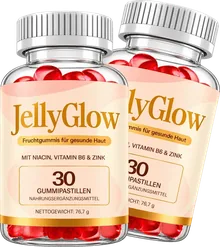
2 jars
60 gummies · about 60 days at one a day
$79per jar, incl. VAT
- Total
- $158
- Per gummy
- $2.63
- Shipping
- $20 shipping
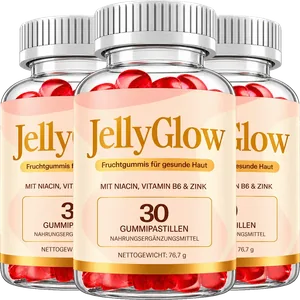
3 jars
90 gummies · about 90 days at one a day
$69per jar, incl. VAT
- Total
- $207
- Per gummy
- $2.30
- Shipping
- Free shipping
6 jars
180 gummies · about 180 days at one a day
$49per jar, incl. VAT
- Total
- $294
- Per gummy
- $1.63
- Shipping
- Free shipping
- Check the delivery countryThe shipping page names Germany only. Ask the helpdesk first if you live elsewhere.
- Pick a package2, 3 or 6 jars of 30 gummies, with VAT. The 2-jar package adds $20 shipping.
- Pay through Digistore24The seller says it is a one-time payment, no subscription. Read the total before you pay.
- Save the order emailIt holds your order ID. The 30-day guarantee counts from the day the jars arrive.


 Badges supplied by the seller (German originals). What each one means is explained on the guarantee page.
 Card logos come from the seller's pack; the official pages name no payment methods. Order links are marked sponsored. Ask your doctor first if you take medicine.
What does the niacin skin claim on the label mean?
The label prints one health statement, word for word: "Niacin contributes to the maintenance of normal skin." It is one of the claims the EU permits for foods that are at least a source of niacin5.
The front of the label reads "Gummies for Healthy Skin†". The dagger points to that same niacin sentence. In other words, "Healthy Skin" on the front is tied to what niacin does for normal skin, and not to anything more.
It helps to be clear about what the sentence does and does not say:
- It describes what the nutrient niacin does in the body for normal skin.
- It is an EU-authorised wording, so the seller may print it only in that form5.
- It does not promise a visible change from JellyGlow Gummies.
- It says nothing about wrinkles, ageing, lines or a "glow".
- It does not describe a timeline or an outcome. The seller itself says individual results may vary1.
The official JellyGlow sales page also uses EU wording for zinc and vitamin B6, which you can find on our EU health claims page1. We do not repeat any other wording the sales page uses about niacin.
Is 25 mg of nicotinamide under the upper limits?
Yes, 25 mg is below every upper limit we found for nicotinamide in adults. The limits differ between the EU and the U.S., because EU sources give a separate figure for each niacin form while the U.S. figure covers both.
| Limit | Applies to | Amount per day | Source |
|---|---|---|---|
| EFSA adult upper limit | Nicotinamide | 900 mg | 6 |
| EFSA adult upper limit | Nicotinic acid | 10 mg | 6 |
| BfR suggested maximum per daily dose in a food supplement | Nicotinamide | 160 mg | 4 |
| BfR suggested maximum per daily dose in a food supplement | Nicotinic acid | 4 mg | 4 |
| U.S. adult upper limit (NIH ODS) | Both supplemental forms | 35 mg | 3 |
| One JellyGlow gummy (label) | Nicotinamide | 25 mg NE | Label |
The tightest figure for the form in the gummy is the U.S. limit of 35 mg a day, which NIH ODS says applies to both nicotinic acid and nicotinamide from supplements3. One gummy uses about 71% of it (25 ÷ 35, our math). That leaves about 10 mg of room under the U.S. figure before you count anything else.
The European Food Safety Authority (EFSA) sets a much higher adult limit for nicotinamide, 900 mg a day6. Our math: one gummy is under 3% of that.
The label says: "Do not exceed recommended dose." One gummy a day is the suggested use, so these comparisons assume one.
ToolUpper-limit check: niacin, B6 and zinc
Add what other supplements give you each day (read their labels). We add one gummy and compare the total with the EU (EFSA) and U.S. (NIH) adult upper limits.
This tool needs JavaScript turned on.
Should you add up niacin from other supplements?
Yes. Upper limits count niacin from all supplements together, so add the 25 mg in JellyGlow Gummies to any niacin in a multivitamin, B-complex or other product you take.
A simple way to check:
- Find "niacin" or "nicotinamide" on each supplement label you use.
- Write down the amount per daily serving.
- Add 25 mg for one JellyGlow gummy.
- Compare the total with the limits in the table above, and bring the list to your pharmacist.
If another product uses nicotinic acid, note that separately, because its EU limit (10 mg) and BfR suggested maximum (4 mg) are much lower than those for nicotinamide6,4. Your pharmacist can tell you how the totals apply to you.
The label says to consult a physician before use, especially if you take a medication, have a medical condition or are under medical supervision. Never start, change or stop a medicine on the basis of this page.
Does a niacin rash mean you need JellyGlow Gummies?
No. A rash is a reason to see a doctor, not a reason to take a supplement. NIH ODS describes severe niacin deficiency, called pellagra, as causing a pigmented rash on skin exposed to the sun3, but many conditions can cause a rash.
Only a doctor can work out what is behind a skin change. Food supplements are not meant for disease: EU rules say their labels must not claim to deal with any human disease7, and the label itself says food supplements must not be used as a substitute for a varied and balanced diet and a healthy lifestyle.
For context, NIH ODS gives the U.S. recommended amount of niacin for adults as 16 mg NE a day for men and 14 mg NE for women3. Many people get niacin from everyday foods. Ask your doctor or pharmacist whether a supplement makes sense for you.
Who should ask a doctor before taking the niacin in JellyGlow Gummies?
The label names the groups who should not use the gummies or should ask first. It says the product is not for use by anyone under 18 or by pregnant or nursing mothers, and that you should consult a physician before use, especially if you take a medication, have a medical condition or are under medical supervision.
Bring these questions to your appointment:
- Does 25 mg of nicotinamide a day fit with everything else I take?
- Do any of my medicines interact with niacin or the other eight ingredients?
- Is there anything about my health history that makes niacin a poor choice?
Our medications page lists what the official sources say about each ingredient and medicines. The research cited there and here studied single ingredients on their own, usually at far larger amounts, not JellyGlow Gummies. We found no study of the product itself.
What does niacin research tell us about JellyGlow Gummies?
It tells us very little directly, because we found no study of JellyGlow Gummies. The facts on this page describe niacin as a nutrient, from NIH ODS and EU sources, not tests of this product3,5.
Here is what we can and cannot confirm:
- We can confirm the amount (25 mg NE), the form (nicotinamide) and the %NRV (156%) from the label.
- We can confirm that the EU niacin skin sentence is an authorised wording5.
- We could not confirm any study of the gummies, any test results or any outcome for people who take them.
The seller says there are no before-and-after photos because the product is new1. If you want details the label does not print, such as raw-material origin, ask the helpdesk at [email protected].
Frequently asked questions
What is the JellyGlow niacin amount per gummy?
Each JellyGlow gummy lists 25 mg NE of niacin, printed as 156% NRV. The suggested use is one gummy a day, so that is also the daily amount from this product.
Do JellyGlow Gummies cause flushing?
We found no source linking nicotinamide, the form in JellyGlow Gummies, to flushing, and NIH ODS says nicotinamide does not cause it3. The flush is linked to nicotinic acid, which the label does not list. If you notice any reaction, stop and ask your doctor or pharmacist.
Does the JellyGlow maker explain choosing nicotinamide?
The seller does not explain its choice, so we could not confirm a reason. What we can say is that NIH ODS describes nicotinamide as having fewer side effects than nicotinic acid3.
What does niacin for skin mean on the JellyGlow label?
The label ties its "Healthy Skin†" wording to the EU sentence "Niacin contributes to the maintenance of normal skin."5 That sentence describes what the nutrient niacin does for normal skin, not a visible change from JellyGlow Gummies.
Sources for this page
L = the printed label. D = the seller's pages and Digistore24. S = health, EU and U.S. government sources.
- D1 JellyGlow official sales page. JellyGlow (jellyglow.site). jellyglow.site
- S12 Regulation (EU) No 1169/2011 on food information to consumers. European Union (EUR-Lex). eur-lex.europa.eu/eli/reg/2011/1169/oj/eng
- S1 Niacin: Fact Sheet for Health Professionals. NIH Office of Dietary Supplements. ods.od.nih.gov/factsheets/Niacin-HealthProfessional
- S14 Maximum levels for the addition of niacin to foods including food supplements. German Federal Institute for Risk Assessment (BfR). www.bfr.bund.de/cm/349/maximum-levels-for-the-addition-of-niacin-to-foods-including-food-supplements.pdf
- S11 Commission Regulation (EU) No 432/2012: list of permitted health claims. European Union (EUR-Lex). eur-lex.europa.eu/eli/reg/2012/432/oj/eng
- S13 Summary of Tolerable Upper Intake Levels (version 11, August 2025). European Food Safety Authority (EFSA). www.efsa.europa.eu/sites/default/files/2024-05/ul-summary-report.pdf
- S21 Directive 2002/46/EC on food supplements. European Union (EUR-Lex). eur-lex.europa.eu/eli/dir/2002/46/oj/eng
Last updated November 25, 2026. Medical review: Dr. Neera Nathan, MD, Physician. Facts come from the printed label, the seller's pages and the public health and EU sources above; prices were checked November 25, 2026. Spotted an error? Email [email protected].