On this page 9 sections
- Is there a study showing how JellyGlow Gummies work?
- What does niacin do, and how much is in JellyGlow Gummies?
- What does vitamin B6 do in JellyGlow Gummies?
- What does zinc do in JellyGlow Gummies?
- What about the maca, amino acids and herbs in JellyGlow Gummies?
- How long does it take for JellyGlow Gummies to do anything?
- Can JellyGlow Gummies replace a balanced diet?
- What do the EU health claims actually mean for how JellyGlow works?
- FAQ
How does JellyGlow work? The honest answer is that we found no study of JellyGlow Gummies, so we cannot describe how the finished gummy works. What we can describe, from NIH and EU sources, is what each nutrient on the label does in the body, and where the evidence for the other ingredients is limited or missing.
Is there a study showing how JellyGlow Gummies work?
No: we found no study of JellyGlow Gummies, and the official pages we checked do not cite one. The seller says individual results may vary and shows no before-and-after photos because the product is new1.
That leaves two kinds of information. The first is the role each nutrient plays in the body, which is well described by health agencies and, for three nutrients, by the EU's list of permitted health claims2. The second is research on the other ingredients, which looked at each ingredient on its own, usually at far larger amounts than one gummy contains. Neither kind tells you what one JellyGlow gummy a day will do for you. For the evidence ingredient by ingredient, see our science page.
What does niacin do, and how much is in JellyGlow Gummies?
Niacin is a B vitamin, and the EU allows the sentence "Niacin contributes to the maintenance of normal skin." for food that is at least a source of it2. The JellyGlow label prints that sentence and lists 25 mg NE of niacin per gummy, 156% of the NRV.
The ingredient list shows the form is nicotinamide. The NIH says nicotinamide does not cause skin flushing and has fewer adverse effects than nicotinic acid, the other main supplement form3. The NIH also notes that severe niacin deficiency, called pellagra, causes a pigmented rash on sun-exposed skin3. That explains why niacin and skin are linked in the rules; it does not mean extra niacin changes skin that is already normal. The U.S. adult upper limit is 35 mg a day for supplemental forms3, and the EFSA adult upper limit for nicotinamide is 900 mg a day4. If you take other supplements, add up the niacin. Our niacin page has the details.
| Ingredient | What the source says |
|---|---|
| Niacin, B6, zinc | Defined nutrients with reference values, upper limits and EU-authorised claims |
| Maca root | Limited human research, small trials |
| L-citrulline | Limited, mixed evidence at gram amounts |
| L-carnitine | The body makes enough in healthy people |
| Grape seed extract | Skin evidence insufficient |
| Panax ginseng | Small, short trials |
| Rhodiola | Not enough reliable evidence |
Sources: NIH ODS, NCCIH, Memorial Sloan Kettering, Cleveland Clinic, EU Regulation 432/2012. We found no study of JellyGlow Gummies themselves.
What does vitamin B6 do in JellyGlow Gummies?
Vitamin B6 is needed for more than 100 enzyme reactions in the body and plays roles in immune function, according to the NIH5. Each gummy lists 2 mg, or 143% of the NRV (label).
The sales page uses the EU sentence "Vitamin B6 contributes to the reduction of tiredness and fatigue."1 We quote it word for word because that is the only way it may be used2. It describes what the nutrient does; it is not a promise about how you will feel after taking JellyGlow Gummies. The NIH says long-term high doses of vitamin B6 can cause nerve damage, and sets the U.S. upper limit at 100 mg a day from all sources5. The EFSA adult upper limit is 12 mg a day4. Again, add up what you take from other products.
Order
JellyGlow Gummies packages and prices
Prices when we checked on November 25, 2026; confirm on the official product page. We do not repeat the page's comparison figures. The buy buttons we checked pointed to a placeholder checkout link, so order links here open the official JellyGlow product page.
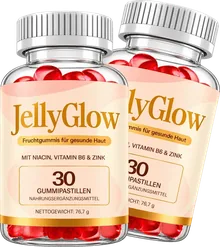
2 jars
60 gummies · about 60 days at one a day
$79per jar, incl. VAT
- Total
- $158
- Per gummy
- $2.63
- Shipping
- $20 shipping
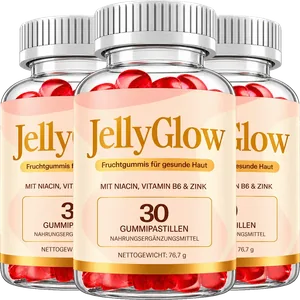
3 jars
90 gummies · about 90 days at one a day
$69per jar, incl. VAT
- Total
- $207
- Per gummy
- $2.30
- Shipping
- Free shipping
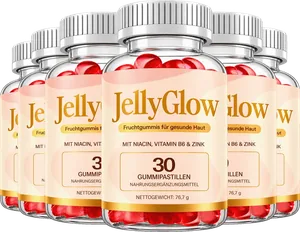
6 jars
180 gummies · about 180 days at one a day
$49per jar, incl. VAT
- Total
- $294
- Per gummy
- $1.63
- Shipping
- Free shipping
- Check the delivery countryThe shipping page names Germany only. Ask the helpdesk first if you live elsewhere.
- Pick a package2, 3 or 6 jars of 30 gummies, with VAT. The 2-jar package adds $20 shipping.
- Pay through Digistore24The seller says it is a one-time payment, no subscription. Read the total before you pay.
- Save the order emailIt holds your order ID. The 30-day guarantee counts from the day the jars arrive.


 Badges supplied by the seller (German originals). What each one means is explained on the guarantee page.
 Card logos come from the seller's pack; the official pages name no payment methods. Order links are marked sponsored. Ask your doctor first if you take medicine.
What does zinc do in JellyGlow Gummies?
Zinc is a mineral with three EU-authorized sentences, all used on the JellyGlow sales page1. Word for word, they are "Zinc contributes to the maintenance of normal skin.", "Zinc contributes to the maintenance of normal hair." and "Zinc contributes to the maintenance of normal nails."2 Each gummy lists 1.5 mg of zinc, 15% of the NRV (label). Like the niacin sentence, these describe what zinc does for normal skin, hair and nails; they do not describe hair growth, stronger nails or any visible change from JellyGlow Gummies.
Fifteen percent of the NRV is the general EU guide to a significant amount6, which is the threshold for being a "source of" a nutrient. For comparison, the NIH lists adult daily needs of 8 mg for women and 11 mg for men, and an adult upper limit of 40 mg a day7. The NIH also says too much zinc can cause nausea, vomiting and stomach upset, and that zinc can interact with some antibiotics, penicillamine and thiazide diuretics7. Talk to your pharmacist if you take any of these.
What about the maca, amino acids and herbs in JellyGlow Gummies?
The other six ingredients have no EU-authorized claim on the label, and the sources we use describe limited or insufficient evidence for them, based on studies of each ingredient alone. Here is a summary:
| Ingredient | Per gummy (label) | What the source says |
|---|---|---|
| Maca root 20:1 extract | 195 mg | Human evidence limited to a few small trials8 |
| L-Citrulline | 35 mg | Evidence limited and mixed; studies used up to 9 grams in a day9 |
| L-Carnitine | 25 mg | Healthy people make enough; supplement studies use grams a day10 |
| Grape seed 20:1 extract | 2 mg | Very little human research for skin; evidence insufficient11 |
| Panax ginseng root 20:1 extract | 2 mg | Safety cautions, including possible medicine interactions12 |
| Rhodiola rosea root 20:1 extract | 1 mg | Reliable evidence insufficient for any health purpose13 |
Maca is the largest active amount on the label. Memorial Sloan Kettering notes that people with certain conditions should consult a doctor before using it8, and another health source describes it as generally considered safe as a food, with limited and often small human studies on supplement claims14. The amino acids are listed in milligrams while the studies used grams. The three herbal extracts are 1 to 2 mg each. Our ingredients page lists everything in label order.
The point of the table is not that these ingredients are useless or harmful. It is that the research describes single ingredients, at their own studied amounts, in groups of people who are not you, and none of it tested JellyGlow Gummies. When an ad turns an ingredient study into a promise about the gummy, it skips that step. If a particular ingredient matters to you because of a health condition or a medicine, your pharmacist is the right person to ask.
How long does it take for JellyGlow Gummies to do anything?
We cannot say, because no source we found gives any timeline for JellyGlow Gummies, and we will not invent one. The seller itself says individual results may vary1.
You may see ads or story cards that mention a day count. The three story cards supplied by the seller describe routines, such as when someone takes their gummy, not results, and we have not verified them. A day count in a story is not a timeline for you. If you are thinking about a skin, hair or nail concern that worries you, see a doctor rather than waiting to see what a supplement does. Our results page explains this further.
Can JellyGlow Gummies replace a balanced diet?
No: the label says "FOOD SUPPLEMENTS MUST NOT BE USED AS A SUBSTITUTE FOR A VARIED AND BALANCED DIET AND A HEALTHY LIFESTYLE." EU rules require that kind of statement on every food supplement15.
The label also gives the suggested use: "As a food supplement for adults, take ONE (1) gummy once a day." and warns "Do not exceed recommended dose." A few practical points follow from the label:
- Take one gummy a day; the label does not suggest more.
- Do not use them if you are under 18, pregnant or nursing (label).
- Check other supplements for niacin, vitamin B6 and zinc, and add up the totals.
- Store the jar in a cool dry place below 30°C, which is 86°F by our math (label).
- Consult a physician first if you take a medication, have a medical condition or are under medical supervision (label).
Bring the jar or a photo of the label when you ask your doctor or pharmacist about JellyGlow Gummies. Never start, change or stop a medicine because of a supplement.
What do the EU health claims actually mean for how JellyGlow works?
The EU claims describe what a nutrient does for normal body function, not what a particular product will visibly do. They are allowed on any food that meets the "source of" threshold for that nutrient2.
So when the label says "Niacin contributes to the maintenance of normal skin.", it is describing niacin, the nutrient, in the same words that any qualifying food could use. It is not evidence that JellyGlow Gummies were tested, and it is not about wrinkles, aging or a glow. The seller says the gummies are not intended to remove wrinkles and makes no promise of younger skin1. Read our EU health claims guide for how these sentences work and what they do not cover.
Frequently asked questions
What is the JellyGlow Gummies mechanism, in plain terms?
We could not confirm any mechanism for the finished gummy, because we found no study of JellyGlow Gummies. We can only describe what niacin, vitamin B6 and zinc do in the body, using the EU-authorized wording2.
How long does JellyGlow take to get through one jar?
One jar holds 30 gummies, so at one gummy a day it lasts about 30 days (label, our math). No source gives a timeline for any effect, and the seller says individual results may vary1.
Which JellyGlow Gummies nutrients have a skin role in the EU wording?
Niacin and zinc are the only ones, each with an EU sentence about the maintenance of normal skin2. The other seven actives have no authorized claim, and none of the wording describes a visible change.
Where does JellyGlow science stop and marketing start?
Do JellyGlow Gummies work if my diet is already balanced?
We could not confirm any extra effect for people with a balanced diet. The label says food supplements must not be used as a substitute for a varied and balanced diet.
Sources for this page
L = the printed label. D = the seller's pages and Digistore24. S = health, EU and U.S. government sources.
- D1 JellyGlow official sales page. JellyGlow (jellyglow.site). jellyglow.site
- S11 Commission Regulation (EU) No 432/2012: list of permitted health claims. European Union (EUR-Lex). eur-lex.europa.eu/eli/reg/2012/432/oj/eng
- S1 Niacin: Fact Sheet for Health Professionals. NIH Office of Dietary Supplements. ods.od.nih.gov/factsheets/Niacin-HealthProfessional
- S13 Summary of Tolerable Upper Intake Levels (version 11, August 2025). European Food Safety Authority (EFSA). www.efsa.europa.eu/sites/default/files/2024-05/ul-summary-report.pdf
- S2 Vitamin B6: Fact Sheet for Consumers. NIH Office of Dietary Supplements. ods.od.nih.gov/factsheets/VitaminB6-Consumer
- S12 Regulation (EU) No 1169/2011 on food information to consumers. European Union (EUR-Lex). eur-lex.europa.eu/eli/reg/2011/1169/oj/eng
- S3 Zinc: Fact Sheet for Health Professionals. NIH Office of Dietary Supplements. ods.od.nih.gov/factsheets/Zinc-HealthProfessional
- S9 Maca. Memorial Sloan Kettering Cancer Center, About Herbs. www.mskcc.org/cancer-care/integrative-medicine/herbs/maca
- S5 Dietary Supplements for Exercise and Athletic Performance: Fact Sheet for Consumers. NIH Office of Dietary Supplements. ods.od.nih.gov/factsheets/ExerciseAndAthleticPerformance-Consumer
- S4 Carnitine: Fact Sheet for Health Professionals. NIH Office of Dietary Supplements. ods.od.nih.gov/factsheets/Carnitine-HealthProfessional
- S6 Grape Seed Extract. NIH National Center for Complementary and Integrative Health (NCCIH). www.nccih.nih.gov/health/grape-seed-extract
- S7 Asian Ginseng. NIH National Center for Complementary and Integrative Health (NCCIH). www.nccih.nih.gov/health/asian-ginseng
- S8 Rhodiola. NIH National Center for Complementary and Integrative Health (NCCIH). www.nccih.nih.gov/health/rhodiola
- S10 Is Maca Root Good for You?. Cleveland Clinic. health.clevelandclinic.org/maca-root-benefits
- S21 Directive 2002/46/EC on food supplements. European Union (EUR-Lex). eur-lex.europa.eu/eli/dir/2002/46/oj/eng
Last updated November 25, 2026. Medical review: Dr. Neera Nathan, MD, Physician. Facts come from the printed label, the seller's pages and the public health and EU sources above; prices were checked November 25, 2026. Spotted an error? Email [email protected].