On this page 10 sections
- Which EU health claims does JellyGlow Gummies use?
- What is Regulation 432/2012?
- Do the JellyGlow Gummies amounts meet the claim conditions?
- What does "maintenance of normal skin" mean for JellyGlow Gummies?
- What do the zinc hair and nails claims mean on JellyGlow Gummies?
- What does the vitamin B6 claim on JellyGlow Gummies say?
- Which JellyGlow Gummies ingredients have no EU health claim?
- How do EU health claims differ from U.S. supplement claims?
- Who should talk to a doctor about JellyGlow Gummies claims?
- FAQ
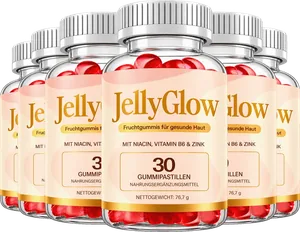
JellyGlow Gummies health claims are five sentences taken word for word from the EU's official list of permitted health claims: one about niacin and skin, three about zinc and skin, hair and nails, and one about vitamin B6. The label prints only the niacin sentence; the official JellyGlow sales page adds the other four1,2.
Which EU health claims does JellyGlow Gummies use?
JellyGlow uses five authorised sentences from Commission Regulation (EU) No 432/2012, the EU's list of permitted health claims1. Each is quoted here exactly as the regulation words it:
| Claim, word for word | Nutrient | Where JellyGlow uses it |
|---|---|---|
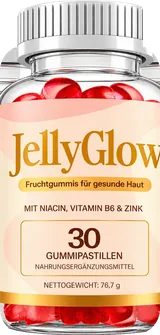
| "Niacin contributes to the maintenance of normal skin." | Niacin | Label (the † on the front) and sales page |
| "Zinc contributes to the maintenance of normal skin." | Zinc | Sales page only |
| "Zinc contributes to the maintenance of normal hair." | Zinc | Sales page only |
| "Zinc contributes to the maintenance of normal nails." | Zinc | Sales page only |
| "Vitamin B6 contributes to the reduction of tiredness and fatigue." | Vitamin B6 | Sales page only |
The label and sales page placements come from our reading of the label wrap and the official JellyGlow sales page2. No other health sentence on the label comes from the EU list. Our label page shows where the niacin sentence sits on the jar.
What is Regulation 432/2012?
Regulation (EU) No 432/2012 is the European Commission's list of health claims that foods, including food supplements, may use in the EU, along with the conditions for using each one1. A claim not on the list, or reworded, is not an authorised claim.
That is why the wording matters so much. The regulation authorises the exact sentence, not a looser version of it. "Niacin contributes to the maintenance of normal skin" is allowed; turning it into a promise about appearance would be a different, unauthorised statement. The same applies to the zinc and vitamin B6 sentences.
When you read an ad or a product page, a few signs tell you a sentence has gone beyond the authorised wording:
- It names a visible result, such as fewer wrinkles, a "glow" or younger-seeming skin.
- It gives a timeline, such as a change after a set number of days or weeks.
- It credits the product rather than the nutrient, for example "these gummies give you" instead of "zinc contributes to".
- It credits an ingredient that has no authorised claim, such as maca or ginseng.
- It compares the gummies with a cosmetic procedure, which no authorised claim supports and which the sales page itself says the product is not a substitute for2.
Any one of these means you are reading marketing, not one of the five authorised sentences. The matcher below lets you test a sentence yourself.
The list also sets a condition: each claim may be used only for a food that is at least a "source of" that nutrient, as defined in EU nutrition-claim rules1. EU labelling rules use 15% of the Nutrient Reference Value as the general guide to a significant amount3.
| Nutrient | Per gummy | NRV | % NRV |
|---|---|---|---|
| Niacin | 25 mg | 16 mg | 156% |
| Vitamin B6 | 2 mg | 1.4 mg | 143% |
| Zinc | 1.5 mg | 10 mg | 15% |
Sources: the label and Regulation (EU) No 1169/2011, Annex XIII. Our math matches the printed percentages.
Do the JellyGlow Gummies amounts meet the claim conditions?
By our reading, niacin and vitamin B6 are well above the 15% guide, and zinc sits right at it. The label gives niacin at 156% NRV, vitamin B6 at 143% and zinc at 15%.
Those percentages follow from the EU NRVs of 16 mg for niacin, 1.4 mg for vitamin B6 and 10 mg for zinc3:
- Niacin: 25 mg per gummy, 156% (our math matches the label).
- Vitamin B6: 2 mg per gummy, 143%.
- Zinc: 1.5 mg per gummy, 15%.
Meeting a condition means a product may use the sentence. It does not mean the product has been shown to do anything, and the regulation does not test individual products. We found no study of JellyGlow Gummies themselves. Our zinc page looks more closely at the 1.5 mg line.
Order
JellyGlow Gummies packages and prices
Prices when we checked on November 25, 2026; confirm on the official product page. We do not repeat the page's comparison figures. The buy buttons we checked pointed to a placeholder checkout link, so order links here open the official JellyGlow product page.
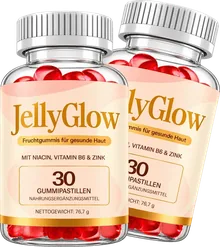
2 jars
60 gummies · about 60 days at one a day
$79per jar, incl. VAT
- Total
- $158
- Per gummy
- $2.63
- Shipping
- $20 shipping
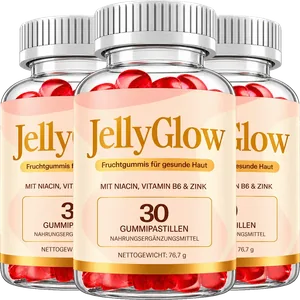
3 jars
90 gummies · about 90 days at one a day
$69per jar, incl. VAT
- Total
- $207
- Per gummy
- $2.30
- Shipping
- Free shipping
6 jars
180 gummies · about 180 days at one a day
$49per jar, incl. VAT
- Total
- $294
- Per gummy
- $1.63
- Shipping
- Free shipping
- Check the delivery countryThe shipping page names Germany only. Ask the helpdesk first if you live elsewhere.
- Pick a package2, 3 or 6 jars of 30 gummies, with VAT. The 2-jar package adds $20 shipping.
- Pay through Digistore24The seller says it is a one-time payment, no subscription. Read the total before you pay.
- Save the order emailIt holds your order ID. The 30-day guarantee counts from the day the jars arrive.


 Badges supplied by the seller (German originals). What each one means is explained on the guarantee page.
 Card logos come from the seller's pack; the official pages name no payment methods. Order links are marked sponsored. Ask your doctor first if you take medicine.
What does "maintenance of normal skin" mean for JellyGlow Gummies?
It means the nutrient has a role in keeping normal skin normal; it does not mean you will see a change from JellyGlow Gummies. The sentence is about what niacin, or zinc, does in the body, not about wrinkles, ageing, a "glow" or how skin looks.
A useful contrast comes from NIH: severe niacin deficiency (pellagra) causes a pigmented rash on sun-exposed skin4. That is the kind of role the word "normal" points to, the nutrient's place in ordinary body function. It is not a reason to take a supplement, and if you have a skin concern, a doctor or pharmacist is the right person to ask.
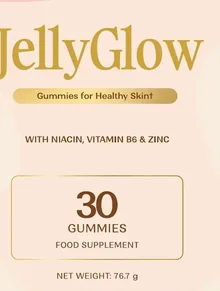
The front line "Gummies for Healthy Skin†" is printed with a dagger precisely so it reads together with the niacin sentence. Read the two as one statement about the nutrient. More on our skin, hair and nails page and our niacin page.
What do the zinc hair and nails claims mean on JellyGlow Gummies?
They say zinc contributes to the maintenance of normal hair and normal nails, and nothing more. The sales page uses them; the label does not print them2.
They do not say the gummies grow hair or change nails. They describe a nutrient's ordinary role, like the skin sentences. NIH notes that adults need 8 mg (women) to 11 mg (men) of zinc a day from all sources, that too much zinc can cause nausea and stomach upset, and that zinc can interact with some antibiotics, penicillamine and thiazide diuretics5. Ask a pharmacist before adding zinc if you take any of these.
What does the vitamin B6 claim on JellyGlow Gummies say?
The sales page uses one vitamin B6 sentence, exactly: "Vitamin B6 contributes to the reduction of tiredness and fatigue."2,1 It is not printed on the label.
That sentence describes a role of vitamin B6 as a nutrient. It is not a statement that JellyGlow Gummies change how you feel, and we do not reword it. NIH notes vitamin B6 is needed for more than 100 enzyme reactions in the body and that long-term high doses can cause nerve damage6. One gummy lists 2 mg, under the EFSA adult upper limit of 12 mg a day7. The sales page also makes two further statements about niacin and vitamin B6 that we do not repeat here. See our vitamin B6 page.
ToolClaim matcher: does an ad stay inside the EU wording?
Paste a sentence from an ad or pick an example. We compare it with the five EU-authorised claim sentences and highlight words that go further. Nothing is sent anywhere.
This tool needs JavaScript turned on.
Which JellyGlow Gummies ingredients have no EU health claim?
Six of the nine actives have no EU-authorised claim on this product: maca, L-citrulline, L-carnitine, grape seed, Panax ginseng and rhodiola. Neither the label nor the authorised list gives them a health sentence here.
What health sources say about them comes from research on each ingredient on its own, usually at far larger amounts, not on JellyGlow Gummies. For example, NCCIH says reliable evidence is insufficient to show that rhodiola is useful for any health purpose8, and that human research on grape seed extract for skin is very limited9. One gummy lists only 1–2 mg of each of these three.
The sales page also says JellyGlow is not intended to remove wrinkles, is not a Botox or hyaluronic acid substitute, and makes no promise of younger skin2. We agree: the gummies are not a substitute for Botox or any cosmetic or medical procedure, and no authorised claim says otherwise.
How do EU health claims differ from U.S. supplement claims?
The EU authorises fixed sentences in advance, while the U.S. lets supplements describe effects on normal body structure or function with a disclaimer that FDA has not evaluated the claim10. JellyGlow is sold as an EU food supplement and uses the EU sentences.
Both systems share one rule in spirit. EU food-supplement rules say a label must not claim that a supplement deals with a human disease11, and in the U.S., FDA does not approve dietary supplements or their claims before sale12. JellyGlow is not FDA approved. Neither system turns an authorised sentence into proof that a specific product works.
Who should talk to a doctor about JellyGlow Gummies claims?
Anyone with a skin, hair or nail concern, anyone who takes a medication, and anyone pregnant, nursing or under 18 should talk to a doctor or pharmacist rather than rely on a label claim. The label asks you to "Consult with a physician prior to use especially if you are taking a medication, have a medical condition or are under medical supervision." Do not start, change or stop a medicine because of a supplement.
Frequently asked questions
How many EU health claims does JellyGlow Gummies quote, and where?
JellyGlow Gummies use five EU health claims: niacin for normal skin, zinc for normal skin, hair and nails, and one vitamin B6 sentence. Only the niacin sentence is printed on the label.
What does the phrase "maintenance of normal skin" mean for JellyGlow?
"Normal skin" means the nutrient has a role in keeping skin's ordinary function; it is not a promise of a visible change. The claims say nothing about wrinkles, ageing or a glow.
What is Regulation 432/2012 and how does it apply to JellyGlow?
Regulation 432/2012 is the EU list of permitted health claims, and JellyGlow quotes five of its sentences. A food may use a claim only if it is at least a source of the nutrient.
Which claims are allowed for JellyGlow Gummies' maca and ginseng?
None: maca, ginseng and the other four non-vitamin actives have no EU-authorised claims allowed on this product. Sources on them describe research on each ingredient alone, not JellyGlow.
How should I read the JellyGlow Gummies healthy skin claim on the front?
Read it as one statement with its dagger: the healthy skin claim ties "Healthy Skin†" to the niacin sentence, which describes the nutrient, not an outcome. The sales page itself says individual results may vary.
Sources for this page
L = the printed label. D = the seller's pages and Digistore24. S = health, EU and U.S. government sources.
- S11 Commission Regulation (EU) No 432/2012: list of permitted health claims. European Union (EUR-Lex). eur-lex.europa.eu/eli/reg/2012/432/oj/eng
- D1 JellyGlow official sales page. JellyGlow (jellyglow.site). jellyglow.site
- S12 Regulation (EU) No 1169/2011 on food information to consumers. European Union (EUR-Lex). eur-lex.europa.eu/eli/reg/2011/1169/oj/eng
- S1 Niacin: Fact Sheet for Health Professionals. NIH Office of Dietary Supplements. ods.od.nih.gov/factsheets/Niacin-HealthProfessional
- S3 Zinc: Fact Sheet for Health Professionals. NIH Office of Dietary Supplements. ods.od.nih.gov/factsheets/Zinc-HealthProfessional
- S2 Vitamin B6: Fact Sheet for Consumers. NIH Office of Dietary Supplements. ods.od.nih.gov/factsheets/VitaminB6-Consumer
- S13 Summary of Tolerable Upper Intake Levels (version 11, August 2025). European Food Safety Authority (EFSA). www.efsa.europa.eu/sites/default/files/2024-05/ul-summary-report.pdf
- S8 Rhodiola. NIH National Center for Complementary and Integrative Health (NCCIH). www.nccih.nih.gov/health/rhodiola
- S6 Grape Seed Extract. NIH National Center for Complementary and Integrative Health (NCCIH). www.nccih.nih.gov/health/grape-seed-extract
- S17 Structure/Function Claims. U.S. Food and Drug Administration. www.fda.gov/food/nutrition-food-labeling-and-critical-foods/structurefunction-claims
- S21 Directive 2002/46/EC on food supplements. European Union (EUR-Lex). eur-lex.europa.eu/eli/dir/2002/46/oj/eng
- S15 FDA 101: Dietary Supplements. U.S. Food and Drug Administration. www.fda.gov/consumers/consumer-updates/fda-101-dietary-supplements
Last updated November 25, 2026. Medical review: Dr. Neera Nathan, MD, Physician. Facts come from the printed label, the seller's pages and the public health and EU sources above; prices were checked November 25, 2026. Spotted an error? Email [email protected].